

After the earlier quantity’s sojourn by means of the Iberian Peninsula, the fourth installment of Severin’s Danza Macabra returns the collection to Italy with a uniformly entertaining quartet of titles that resolutely tick off the bins within the Gothic Cinema We Love guidelines: cobweb-laden crypts, medieval castles and different ruins, inky black shadows (captured in each moody monochrome and creepy colour), and tales of revenge from past the grave. What’s extra, this set additionally provides fascinating takes on a few of horror’s most iconic figures.
An underrated automobile for scream queen Barbara Steele, Massimo Pupillo’s Terror-Creatures from the Grave, from 1965, is a slow-burn gothic chamber piece that rachets up the stress little by little, till the filmmakers let all hell break free within the final quarter-hour. Even then, it’s fascinating to notice precisely how a lot the movie achieves with so little.
Other than some chillingly goopy make-up, the results on show in Terror-Creatures from the Grave encompass little greater than jittery POV digital camera actions and a few cannily thrown shadows. That is positively horror filmmaking within the Val Lewton vein, effectively served by the slinky digital camera strikes and the ravishingly tenebrous monochrome imagery.
Written by Roberto Natale and Romano Migliorini, the movie is about within the 12 months 1911. This enables for a tinge of modernity, within the type of telephones and crank-started vehicles, to paint the in any other case pre-industrial proceedings. As with many a gothic story, the narrative includes the useless hand of the previous coming again to actual grisly revenge upon the current. Right here that’s represented by the stressed spirits of plague spreaders buried on the property of a medieval villa owned by Professor Jeronimus Hauff, who’s been useless virtually precisely a 12 months in the beginning of the movie.
By means of mediumistic pursuits that acquired him booted from the college, Hauff managed to contact and harness the villa’s ghostly inhabitants into looking for revenge for his homicide, threatening alongside the way in which Hauff’s widow Cleo (Steele), daughter Corinne (Mirella Miravidi), and useful lawyer Kovac (Walter Brandi). In a bravura transfer, Pupillo levels the inevitable flashback to Hauff’s demise not as remembered by any of the members, however by placing it on show in a cursed mirror, one other trope typically deployed in gothic literature and movie. Terror-Creatures from the Grave can be uncommon in that it culminates in ritualistic purification by water, somewhat than the extra typical cathartic inferno that concludes many different tales of this kind.
From 1971, Filippo Walter Ratti’s The Night time of the Damned ramps up the eroticism that was somewhat teasingly employed in Pupillo’s movie, with its fleeting glimpses of individuals’s naked backs and sides, as an alternative tipping over into envelope-pushing softcore at instances. Like Terror-Creatures from the Grave, Ratti’s movie may have been set a whole lot of years in the past, save for a number of flashes of the trendy day, which, on condition that they’re principally taken up with ongoing homicide investigations, may align the movie with the giallo craze that was simply then kicking into overdrive.
Because the movie owes a transparent debt to “The Fall of the Home of Usher,” it comes as little shock that early on it name-drops Charles Baudelaire, who was an early advocate and translator of Edgar Allan Poe. Screenwriter Aldo Marcovecchio cleverly works the nod right into a plot level involving a hidden code, one thing that wouldn’t have been misplaced in a Poe story like “The Gold Bug.” The related quotes additionally sign Baudelaire’s curiosity within the ineluctable hyperlink between intercourse and loss of life, a perverse and decadent connection the movie pursues in its personal inimitable method.
Famend journalist Jean Duprey (Pierre Brice), alongside along with his spouse, Danielle (Patrizia Viotti), is summoned to the distant and allegedly haunted mansion of his childhood buddy Prince Guillaume de Saint Lambert (Mario Carra). Ushered into the home by Guillaume’s spouse, Rita (Angela De Leo), they’re knowledgeable that Guillaume is affected by a type of hereditary illness that provides him suits and sends him into spells of frenzied violin enjoying. Finally, it seems that every one this has to do with a witch burned on the stake by one among Guillaume’s ancestors again within the seventeenth century, although this growth extra readily suggests the works of Poe’s confrere Nathaniel Hawthorne, notably The Home of the Seven Gables.
Ratti’s movie invokes a time-honored gothic trope by depicting two girls with very totally different inclinations: dark-haired femme fatale Rita and blond naif Danielle. What’s extra, the movie follows different works of Italian gothic cinema like Mario Bava’s Black Sunday that conflate the figures of the witch and the vampire. Although Guillaume is Rita’s first sufferer, we by no means see any overt acts of predation in opposition to him, whereas, when she turns her consideration to Danielle, we’re handled to protracted intercourse scenes that additional contain a number of sapphic intercourse slaves.
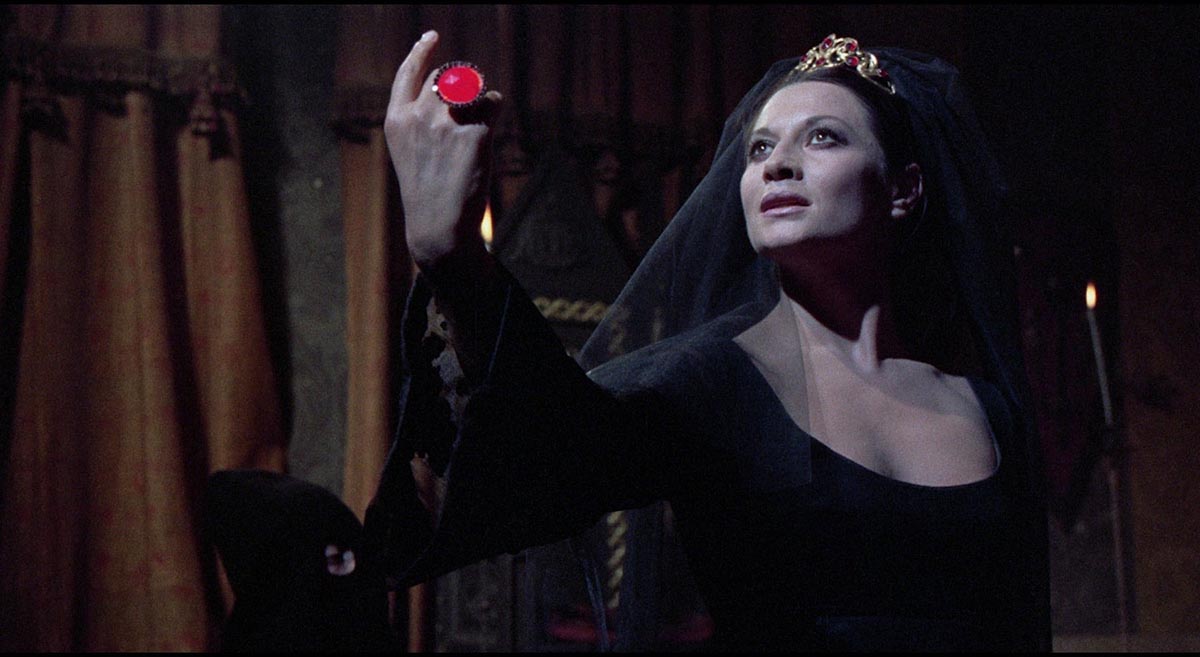
These softcore scenes are likely to bathroom down the movie’s pacing, particularly within the ultimate act, when it needs to be tightening up. The finale additionally resolves itself fairly abruptly, virtually as if elements of it weren’t filmed owing to price range constraints. However the story is intelligent and effectively executed. The movie is loaded with gothic ambiance, exquisitely shot in lurid colour by cinematographer Girolamo La Rosa, and boasts a terrifically atmospheric rating from composer Carlo Savina.
Luigi Batzella’s The Satan’s Marriage ceremony Night time, from 1973, goes complete hog with the allusiveness glimpsed in The Night time of the Damned, folding in realizing references to Poe’s poetry, Wagner’s operas, and the demon Pazuzu from William Peter Blatty’s 1971 novel The Exorcist (a 12 months earlier than the movie model). The narrative brings collectively the 2 most iconic vampires in movie historical past: Depend Dracula and Countess Bathory. And, as if all this weren’t sufficient, Batzella’s movie lifts a few key plot factors from Roman Polanski’s The Fearless Vampire Killers.
It’s all performed in a lightweight and playful method, although this doesn’t imply that The Satan’s Marriage ceremony Night time stints on the chilling and even positively psychotronic moments. Witness a spherical of Dionysian wine quaffing that immediately morphs right into a weird psychedelic montage straight out of the finale of Stanley Kubrick’s 2001: A Area Odyssey. And far of the movie’s extra surreal and oneiric imagery wouldn’t be misplaced in a Jean Rollin movie.
Mark Damon (the male lead of Roger Corman’s House of Usher) does double obligation enjoying Karl and Franz Schiller, twins of noticeably divergent inclinations: one sober and studious, the opposite an opportunistic wastrel. Style icon Rosalba Neri (the feminine lead of Girl Frankenstein, which was included on the primary quantity of Danza Macabra) performs Countess Dolingen de Vries. In one other of the movie’s literate video games, her identify is a riff on the Bram Stoker story Dracula’s Visitor. By the movie’s blood-soaked climax, it turns into clear that she is actually Dracula’s widow, out to reincarnate him utilizing a Satanic ritual and Karl’s physique because the host.
The Satan’s Marriage ceremony Night time comprises much less flesh than The Night time of the Damned, however we’re handled to the indelible picture of the resplendent Rosalba Neri slowly rising from a fog-shrouded tomb lined solely by the blood of the most recent virgin sacrificed to her everlasting youth and wonder. The movie additionally displays traits within the softcore cinema of the period with its prolonged depiction of a tryst between Damon and Neri, the latter displaying off fairly much more of her property than her male co-star.
In line with the altering tenor of the instances in post-Night time of the Residing Useless horror cinema, the filmmakers give their gothic story a downbeat ending. In contrast to Terror-Creatures from the Grave and The Night time of the Damned, which conclude with the restoration of the established order as embodied in a pair of romantic lovers, The Satan’s Marriage ceremony Night time closes on an ironic and ambiguous notice that portends the unfold of its hitherto contained vampiric plague.
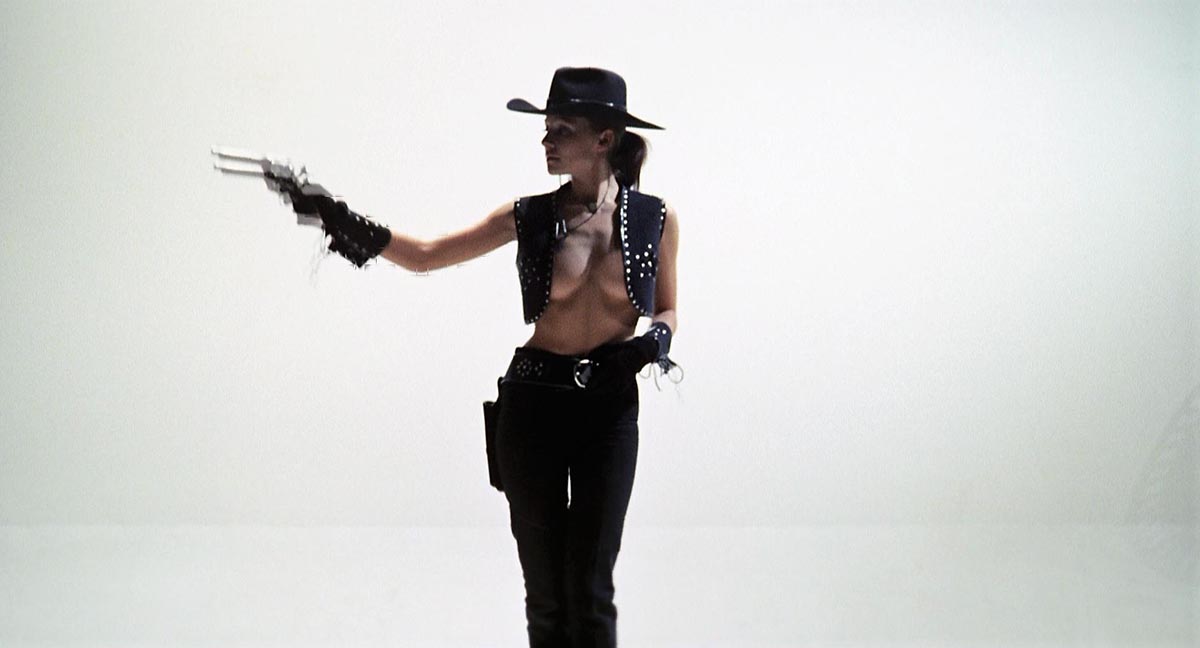
Additionally launched in 1973, Baba Yaga is an adaptation of Guido Crepax’s erotic comedian by writer-director Corrado Farina, whose They Have Modified Faces could be discovered within the second quantity of Danza Macabra. The story begins when Milanese trend photographer Valentina Rosselli (Isabelle De Funès) runs into an older lady who refers to herself as Baba Yaga (Carroll Baker), a reputation that alludes to a determine of Slavic folklore. Baker’s glamorous, gauzy Norma Desmond-inflected portrayal of the character doesn’t precisely gibe with what we count on of a cannibalistic crone who swoops across the forest in an outsized mortar wielding a large pestle.
As a result of Valentina is a shutterbug by occupation, and her lover, Arno (George Eastman), a industrial director, the movie is besotted with photographs. Proper off the bat, Farina invokes Crepax’s sinuous pen-and-ink paintings for the opening title playing cards, and later sequences within the movie even replicate the association of panels in Crepax’s fumetti (or comedian strips) through the use of black-and-white nonetheless photographs, particularly for a love scene that rigorously fragments the lovers’ constituent anatomies. Carrying by means of on this motif, Baba Yaga finally ends up apparently cursing Valentina’s favourite digital camera, in order that some mishap befalls anybody she shoots.
Regardless of its folkloric connection, Baba Yaga is the least overtly gothic movie on this Danza Macabra set. Baba Yaga’s “lair” is not any ruined fort, not to mention a hut propped up on spindly hen legs; it’s nothing greater than a rundown villa filled with early-Twentieth-century appurtenances like gramophones and guide typewriters. Essentially the most uncanny amongst these decorations is a russet-haired doll all gussied up in leather-based dominatrix gear that Baba Yaga calls Annette and summarily bequeaths to Valentina. When the doll magically comes alive late within the movie, she’s performed by Ely Galleani, a veteran of Italian style cinema.
Annette ties the movie into one other preoccupation that runs all through Crepax’s physique of labor: sadomasochistic eroticism. This fixation is signaled early on when Valentina pages by means of a quantity of Marquis de Sade’s Crimes of Love. Although there’s just one somewhat restrained scene of bondage and self-discipline, it’s sufficient to align Baba Yaga with different European erotica like The Libertine, The Punishment, or any of the movies of Alain Robbe-Grillet from the interval.
Severin has given all 4 movies within the set impeccable 4K restorations and, for the primary time within the collection, makes them obtainable on UHD discs in addition to commonplace Blu-rays. Every title is accompanied by a satisfying vary of extras, together with solid and crew interviews, visible essays, and commentary tracks, even a CD of soundtrack cues from composer Piero Umiliani. The set gives one other bounteous serving to of spectral pleasures for the gothically inclined viewer, proving as soon as once more that the underside of this explicit barrel is completely nowhere in sight.
Danza Macabra Volume Four: The Italian Gothic Collection is now obtainable.
Since 2001, we have introduced you uncompromising, candid takes on the world of movie, music, tv, video video games, theater, and extra. Independently owned and operated publications like Slant have been hit laborious in recent times, however we’re dedicated to retaining our content material free and accessible—which means no paywalls or charges.
When you like what we do, please contemplate subscribing to our Patreon or making a donation.